
From small group to partner reading to build reading fluency
Many teachers tell us that getting uninterrupted time for high-quality small group reading can be tough. In the Little Learners Love Literacy® (LLLL) approach, partner reading is one of the most effective routines for creating that space. Once embedded, this short, daily fluency routine builds reading confidence, independence and accountability – all while freeing you up to focus on targeted small-group instruction.
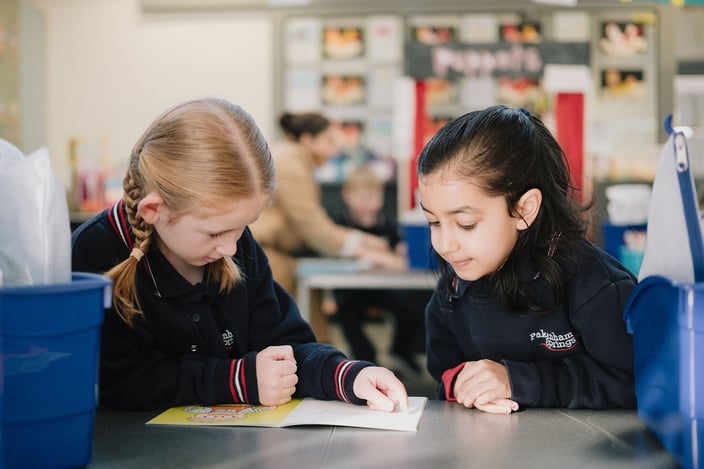
 What is partner reading in primary school classrooms?
Partner reading is a simple, structured fluency routine where students work in pairs to read a decodable book or fluency passage aloud. One partner reads while the other listens and tracks, giving feedback as needed. Then they switch roles. This supported, repeated reading strengthens fluency, confidence and comprehension over time.
When should we do partner reading?
Partner reading takes place during the Apply phase of your LLLL lesson – right when you're working with a small group on targeted instruction.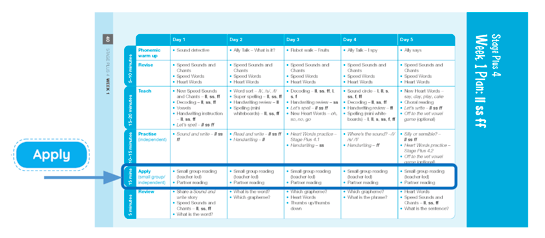
Timeframe: Approximately 10–15 minutes, short and sharp
Structure: Students work in fixed pairs with a decodable text aligned to your scope and sequence
Focus: Fluency – accuracy, prosody and comprehension – through repeated, supported reading
Frequency: Daily
Once students are taught the routine, partner reading becomes a truly independent fluency task. While you work explicitly with a small group, the rest of the class stays meaningfully engaged – reading, re-reading and giving feedback to their partner.
What texts should we use for partner reading?
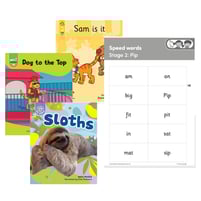 Fluency doesn’t develop by chance – it needs deliberate, structured and supported practice. That means using the right texts: ones aligned to your phonics instruction and purpose-built for partner reading.
Foundation–Year 1
Use LLLL decodable books and Speed Words aligned to your phonics instruction.
- These texts support repeated reading with a known code.
- Students can revisit the same book across 3–5 days to build confidence, accuracy and prosody.
- Speed Words can be used as a warm-up before students begin reading, or in place of a book or passage of text.
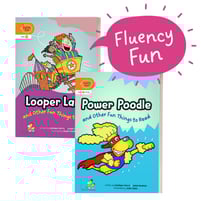
Year 2
Use Fluency Fun texts – short, structured texts designed for building fluency through repeated partner reading.
- Text types include stories, plays, poems, nonfiction and more.
- They are pitched just right for developing expressive, fluent reading.
"Students need to practise and apply their growing word-identification skills to appropriate texts."
- Pikulski & Chard, 2005
How to implement partner reading into your routine
Partner reading is a short, structured routine where students work in pairs to build fluency through supported, repeated reading. It follows a simple reciprocal process: read, listen, give feedback, swap. It works best when it’s explicitly modelled and consistently practised. Once students are taught what to do, and can do it well, the routine becomes independent and impactful.
 Here’s how to get started:
- Assign fixed partners: Decide how you’ll pair students: by similar or mixed ability. Both approaches are supported in research. What matters most is clarity and consistency. Assign students a clear role/label. For example, Grapes/Oranges or A/B.
- Allocate the text: Choose a decodable book or fluency text that students can read independently.
Foundation–Year 1: use LLLL decodable books and Speed Words.
Year 2: use Fluency Fun texts. - Model the routine: Set clear expectations for students before they begin partner reading.
- Model the routine explicitly. Show how students will take turns reading, tracking and giving feedback.
- Model the text or briefly set a purpose if the text is familiar (e.g. a decodable reader from a small group reading session).
- Prepare students to read successfully with a quick reminder of their roles.
- Run the routine: Once students know their roles, it's time to put the routine into action.
- Timeframe: keep each session short, around 10 to 15 minutes.
- Repetition builds fluency: students may read the same text multiple times in one session. Make sure they know that one read does not mean the task is finished.
- Partner roles: partners alternate between reading and listening each time, following the expectations you’ve modelled.
- Feedback matters: teach students to give specific feedback during and after each read. You might hear: “That was much smoother!”, “You didn’t skip any words that time.”, “Great pausing at the commas!”
Extend the routine with follow-up tasks reinforcing fluency, comprehension and writing
Once students are confident with the partner reading routine, you can extend it with simple follow-up tasks that reinforce fluency, comprehension and writing; for example, Read, write and draw, My Word Detective Book or Find, answer, write activities.
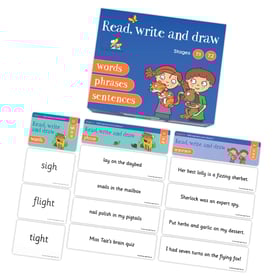 Read, write and draw
This activity builds fluency and supports handwriting, spelling and comprehension. Students read a card, re-read it to their partner, then write it and draw a picture to show understanding.
The cards come in three ways – words, phrases and sentences – making it easy to differentiate. You can find out more about Read, write and draw here.
My Word Detective Book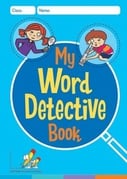
This is a personal spelling dictionary aligned to the LLLL stages. After reading, students revisit the words that match the focus sound and spelling. They write them in lists, highlight the grapheme, and later use their book to support writing full sentences with those words.
Fluency Fun – Find, answer, write
-Oct-15-2025-04-17-13-9746-AM.png?width=261&height=261&name=Untitled%20design%20(2)-Oct-15-2025-04-17-13-9746-AM.png) From Monday to Thursday, students re-read the Fluency Fun texts and complete the Find, answer, write activity. This encourages deeper comprehension by prompting students to return to the text, locate key information, and respond in writing.
From Monday to Thursday, students re-read the Fluency Fun texts and complete the Find, answer, write activity. This encourages deeper comprehension by prompting students to return to the text, locate key information, and respond in writing.
On Fridays, students participate in reader’s theatre. They work with a weekly play, poem, or dialogue-rich text from the series to practise reading with expression and confidence.
Top tips for success: Your partner reading checklist
- Students need to know their partner!
- Pair students intentionally, for example by similar reading ability, or by pairing developing readers with more advanced readers who can support their fluency.
- Within each partner pair, designate one student a ‘grape’ and one student an ‘orange’ (or whatever fun name you like!) This way students will know who you are referring to when you say, 'Today, "oranges" read first!'.
- Error correction is an important part of this routine – students need to know how to do this and practise doing it. Provide them with sentence starters and lots of feedback when you hear partners giving feedback.
- Ensure you allocate the reading material, not the students. Partner reading will work best when the level of the text is right for independent fluency work.
- As students progress through the program, decodable books inevitably get longer. Passages or splitting a book over sessions may be necessary to keep the sessions timely.
Dedicate the first week or two of term to mastering key routines and behaviours (such as partner reading and using mini whiteboards) before you begin to teach content, as recommended by Anita Archer in her explicit instruction guidance. In a busy classroom it can be hard to prioritise doing this, but it is really worth it!
Explore the partner reading resources from Little Learners Love Literacy®:


.png?width=500&height=100&name=Blog%20headings%20(1).png)

Curious to learn exactly how to embed partner reading in your classroom? Join us for our free professional learning webinar. We’ll unpack the routine and give you practical tips for success.
With a structured literacy approach, we are always learning and refining our practice. No routine runs perfectly on day one, which is why it helps to prioritise and focus. Maybe partner reading is your next routine to embed for 2026?
Good luck!