
How might a student go about reading or spelling a word like unhelpful?
Do they try to work it out letter by letter?
u-n-h-e-l-p-f-u-l
This can work for short words, but it becomes slow and inefficient for longer words.
Or do they break it into meaningful parts?
un + help + ful
When we break it apart, the word becomes much more manageable. Instead of one long, overwhelming word, we now have three meaningful parts that each carry information. These meaningful parts are called morphemes.
What is morphology and what are morphemes?
The word morphology itself gives us a clue to its meaning. Morph comes from the Greek word morphē, meaning “form”, and -ology means “the study of”. So morphology literally means “the study of form”.
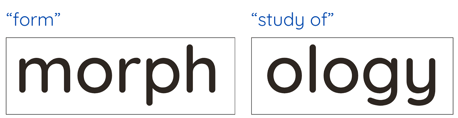
In literacy, we use this to mean the study of how words are formed.
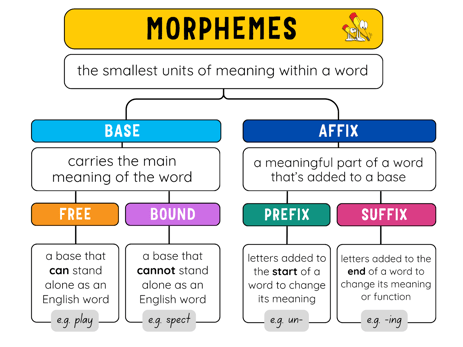
Morphology is the study of how words are built from meaningful parts called morphemes. Morphemes are the smallest units of meaning within a word.
Words aren’t just random strings of letters and sounds. They are built from meaningful parts, and morphology helps us understand how those parts work together.
Are morphemes the same as syllables?
Syllables are based on sound, while morphemes are based on meaning. These are not the same thing.
Let’s look at some examples. In most of the words in the table below, the number of syllables don’t match the number of morphemes. We can see that the word unhelpful has 3 syllables and 3 morphemes, but this is not always the case.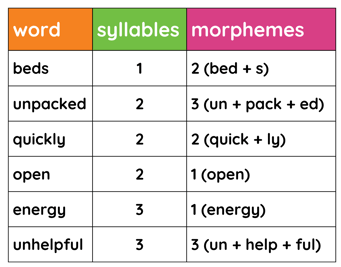
Types of morphemes
Words are built from three main types of morphemes: bases, prefixes and suffixes.
Base
The base carries the main meaning of the word. Bases can be classified into two types:
- Free base: A base that can stand alone as an English word. For example, play. It can be used on its own or combined with other morphemes to form words like playful, playing and replay.
- Bound base: A base that cannot stand alone and must be combined with other morphemes to form a word. For example, spect (look) is a bound base in words like inspect, respect and spectator.
Many bound bases come from Greek or Latin. The Latin root word spect, and its variant spic, both mean “see.”
Affixes (prefixes and suffixes)
An affix is a meaningful part of a word that is added to a base. Affixes include prefixes (added to the beginning) and suffixes (added to the end).
- Prefix: Letters added to the beginning of a word to change its meaning.
For example: un- (unhappy), mis- (miscount) and dis- (disagree). - Suffix: Letters added to the end of a word. A suffix can change the meaning or the function of the word. For example: -ful (helpful), -ly (slowly) and -ed (jumped). Suffixes can give us information about tense, how something is done, or word type.
Why does morphology matter for reading and spelling?
When students understand morphology, they stop seeing words as long strings of letters that need to be memorised. Instead, they see words as built from meaningful parts that they can use to read, spell and understand new words.
For example, a student might need to read the word unbreakable. They can identify the three morphemes to help them decode and understand the word:
un + break + able
(not able to be broken)
A student might want to spell the word unhelpfully. They can identify the four morphemes to help them encode and write the word:
un + help + ful + ly
(in a way that is not helpful)
This understanding of word structure supports reading and spelling, and helps explain changes in pronunciation.
How morphology explains changes in pronunciation
When we add prefixes and suffixes, pronunciation can change, but spelling usually stays the same to show connections in meaning.
This knowledge helps students make more informed spelling choices.
Let’s look at the free base sign. Notice how the pronunciation changes when suffixes are added:
sign → signal → signature
In sign, the g is not pronounced. In signal and signature, the g is pronounced. The pronunciation changes, but the spelling remains consistent to show meaning.
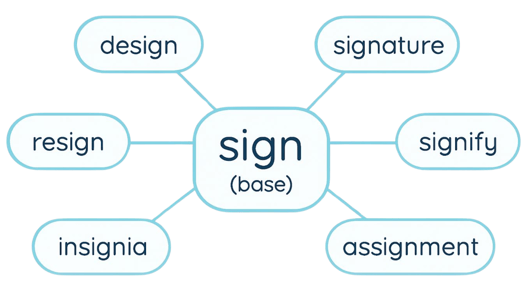
Pronunciation of a base, like sign, can change across the word family.
As students develop their understanding of morphology, it’s important for them to understand that pronunciation can change, but spelling often stays consistent to show meaning and connections between words.
This is also why, when teaching, we recommend spelling out morphemes rather than saying them. For example, we might say f-u-l rather than “ful”, and p-r-e rather than “pre”. This eliminates confusion and keeps the focus on structure.
Is English spelling just random or irregular?
We have all seen the jokes and memes pointing out how strange English spelling can be. At first glance, it can certainly feel that way. But English is not random.
When we look beneath the surface of words and consider morphology, patterns begin to emerge. What appears irregular at the sound level often makes sense when we consider how words are built and how they are connected.
Take words like does and says. From a sound perspective, they can seem unusual. But morphologically, they are not random at all.
Both of these words are built from a base plus a suffix:
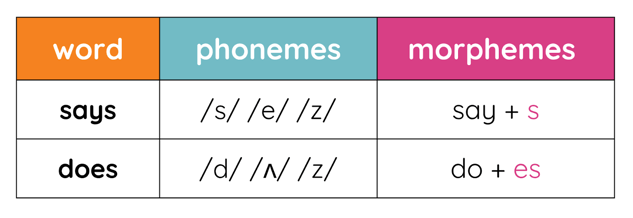
Some teachers may encourage students to memorise words like does and says as irregular words. However, they follow the same structure as other words formed with the suffix -s or -es, such as:
play + s → plays
go + es → goes
The pronunciation shifts, but the spelling stays consistent.
English is not random or chaotic. When we shift our perspective and look at words through a morphological lens, the spelling often makes much more sense.
Why morphology matters in literacy instruction
English is a morphophonemic language, meaning it represents both sound and meaning. Words are built from phonemes (sounds) and morphemes (meaningful parts), so students need knowledge of both to fully understand the written code of English.
Morphology gives students a powerful way to approach unfamiliar words. This is especially important for longer, multisyllabic words, where phonics alone is not always enough.
For example, students may be able to read and spell simple words like jump or joy using their phonics knowledge. However, to read and spell words like jumped, jumping, enjoyable or joyfully they need to understand that words are built from meaningful parts (morphology).
Skilled readers and writers pay attention to prefixes, suffixes and bases to help them read, spell and understand words.
Morphology instruction supports all students
One of the most powerful aspects of morphology instruction is that it supports all learners.
For students who find reading and spelling challenging, including those with dyslexia, morphology provides an invaluable tool. Instead of relying on sound alone, they can use meaningful word parts to support decoding (reading) and encoding (spelling).
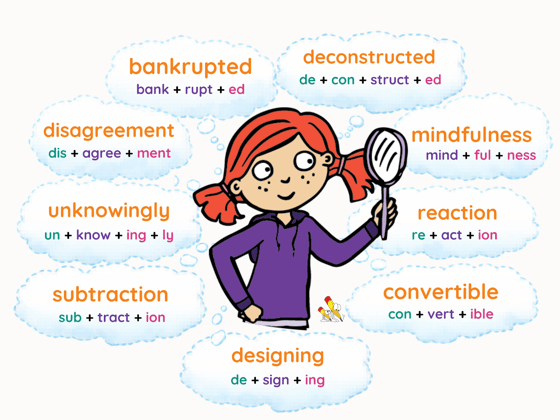
For more confident learners, morphology opens the door to deeper exploration. Once students become word detectives, there is almost no end to what they can uncover about how words work and where they come from.
Morphology should be taught from the beginning
In her book Beneath the Surface of Words, Sue Scibetta Hegland argues that morphology should be integrated from the beginning of school, alongside the typical elements of early literacy instruction.
Little Learners Love Literacy® integrates morphology instruction from Foundation Year, with a carefully constructed sequence that builds in complexity throughout the first three years of school.
“Morphology is not an advanced topic: it’s the foundation of the entire spelling system.”
— Sue Scibetta Hegland
Morphology is key to making sense of English. For many teachers, however, it can feel unfamiliar or even daunting. The good news is you don’t need to have all the answers to get started. You can learn alongside your students by exploring words together, noticing patterns and remaining curious.
Our updated Teacher Activity Resources (TARs) are designed to support this. Morphology is built directly into the lesson notes, so it is clearly planned and visible rather than something extra to fit in.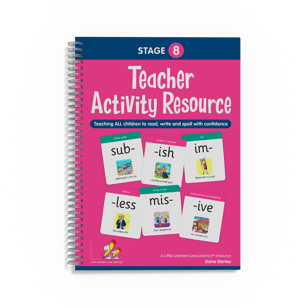 Teachers are supported with clear prompts and consistent instructional language, helping you know exactly what to say and how to introduce each morpheme. This reduces cognitive load and supports more precise teaching.
Students are also given regular opportunities to revisit and apply their learning, helping to build both confidence and a deeper understanding of how words work.
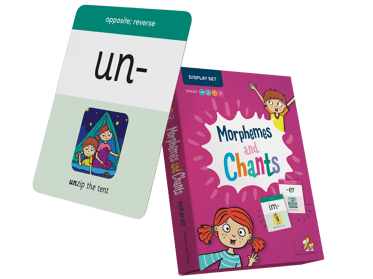
In addition to this, we have some key resources to further support your teaching. Our Morphemes and Chants Cards provide explicit, ready-to-use routines for teaching prefixes and suffixes. The cards display clear meanings, word lists and memorable chants to support understanding and recall.
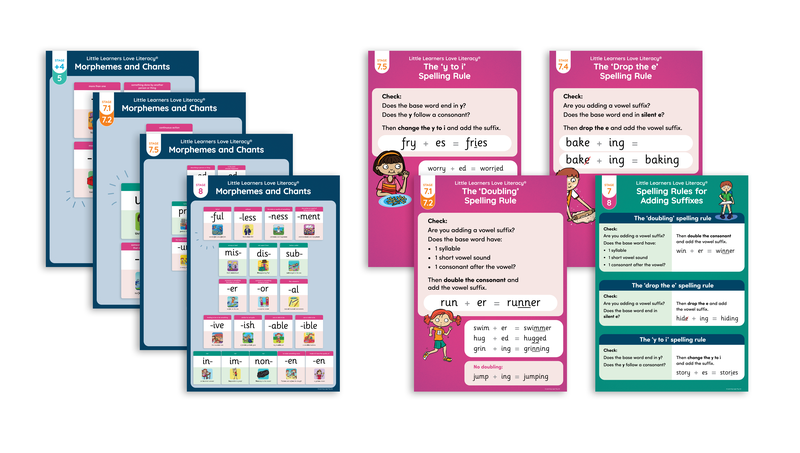
Our Morphology Poster Pack provides simple mnemonics for remembering morphemes, along with key spelling rules for adding suffixes.
 When students begin to understand morphology, something shifts. Words become more manageable, more meaningful and more connected. Students start to notice patterns, make links and approach new words with curiosity.
And for teachers, what once felt complex can become one of the most engaging and even joyful parts of teaching.
We hope this blog has been useful. Please don't hesitate to contact us if you have concerns and/or questions.